Making AI Work: Why Trust Matters More Than Ever
- Vikul Gupta
- Chief Technology Officer
-
Dec 18, 20257 min read
AI has rapidly evolved from an innovation experiment into an operational backbone. What started as small pilots and proof-of-concepts is now deeply embedded in everyday workflows with relevance across multiple sectors – healthcare, energy, financial services, retail, customer service, and public-sector operations. The shift has been fast – and with it has come a new realization: AI’s value is inseparable from its trustworthiness. As organizations move from “what AI can do” to “what AI is allowed to influence,” the questions have changed too. Today, leaders want clarity, accountability, and confidence. They want to know the AI behind their workflows won’t drift, hallucinate, or behave unpredictably. And they want assurance that decisions affecting patients, consumers, and infrastructure are grounded in accuracy, fairness, and safety. This transition marks a very important moment: AI is no longer purely a technical milestone but a governance responsibility.
Early AI adoption was driven by enthusiasm. It was all about capability, automation, and speed. But the more these systems began to impact high-stakes workflows, the greater the expectations. Teams that treated AI like a black box now want visibility into how decisions are made. They want predictable behavior, resilience under pressure, stable performance over time, and protection from bias and manipulation. This shift hasn’t dampened AI ambition; it has simply matured it. Today, enterprises understand that building AI is one challenge-building AI that can be trusted is another altogether.
As AI becomes woven into applications, responsibility for quality naturally expands. Traditional QA teams are suddenly expected to assess not only the application’s functionality but also the underlying behavior of the AI model. They now have to understand bias patterns, test for adversarial vulnerabilities, validate contextual reasoning, and track drift as models encounter new data. This is not the QA of the past – it’s a hybrid discipline that blends software testing, data analysis, risk management, and model-level scrutiny.
Many organizations seek structured guidance for making this shift. Not because they lack the technical skill, but because the implications of unreliable AI extend far beyond defects – they impact trust, safety, compliance, and reputation.
AI systems are fundamentally different from traditional software. Conventional systems are deterministic: fed with the same input, they will always return the exact output. This predictability means that they are straightforward to test, verify, and govern. Unlike them, AI models are non-deterministic: they learn their own internal logic from enormous, sometimes-changing datasets. Even slight changes in input, timing, user behavior, or ambient context may lead to radically different outputs, sometimes in ways difficult to trace or explain.
A well-known, quite simple example is Amazon’s product recommendation engine. What a user sees is not the result of fixed rules, but a constantly shifting model influenced by:
Two users with profiles which may be considered similar can get completely different recommendations within minutes. This is the essence of nondeterministic behavior – strong, adaptive, and naturally unpredictable.
With this comes real risk. Reasoning can be opaque. Performance can degrade without warning. New vulnerabilities may emerge when data shifts. A well-behaved model during testing may behave differently in production just because conditions have changed.
Traditional QA methods, built for stability, simply can’t account for this variability. That is why AI assurance must be proactive, structured, and continuous, woven into the full model lifecycle rather than confined to the end of development.
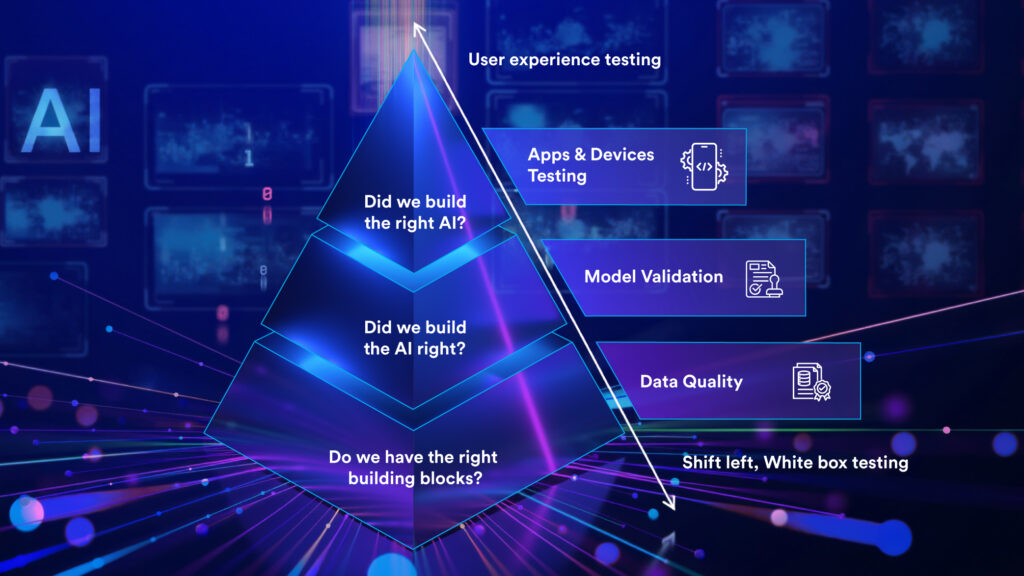
Across industries, the most robust AI programs follow a pyramid-like assurance structure – one built from the ground up:
1. Data foundations: Ensuring the ground is solid
The base of the pyramid deals with the quality and provenance of the data. This includes distribution analysis, bias detection, duplicate or missing value checking, schema integrity verification, and contextual relevance verification. If this base is uneven, every flaw will be inherited by the model. Data quality acts like the first gateway to trust in an organization with mature assurance practices.
2. Model behavior: Testing how AI thinks
The middle layer is where the model reasoning and performance are tested. Accuracy is merely the starting point. This layer includes a set of fairness and toxicity checks, such as stress-testing under edge-case conditions, robustness against prompt manipulation, and ensuring stability when the model confronts new scenarios. It answers the critical question: did we build the AI right?
3. Integrated experience: Ensuring the AI works in the real world
The top of the pyramid is the full system experience. Here, the objective is to confirm that AI-enabled workflows behave predictably across UX interactions, via APIs, through security layers, under different conditions of performance, and within real-world contexts. This layer ensures that the AI is not just correct but usable, interpretable, and aligned with business expectations – ultimately answering the question, did we build the right AI?
Together, these layers form a practical, repeatable model for governing AI at scale-one reflected in many of Qualitest’s assurance engagements, where structure and rigor are used to convert uncertainty into business confidence.
More leaders are gauging AI against three expectations that reflect how humans judge credibility:
When AI is evaluated through this lens, trust becomes measurable – not abstract.
Andrew Duncan, CEO, Qualitest says, “AI is moving into the heart of how organizations operate, which means trust can no longer be optional. The companies that win in this next phase will be the ones that treat assurance as a strategic capability, not a compliance exercise. When you can prove that your data is sound, your models behave predictably, and your systems perform safely in the real world, you unlock scale, reduce risk, and move faster than your competitors. Assured AI is not just about protecting what you have. It is about creating the confidence to innovate, to automate, and to take bolder decisions with clarity. Trust is the real accelerator for AI, and the organizations that build it in from the start will set the pace for everyone else.”
Trustworthy AI for Healthcare
A national healthcare provider introduced AI to streamline member grievance resolution and clinical workflows – areas where ethics, compliance, and patient impact leave zero room for inconsistency. The organization took assurance one step further by checking the completeness and privacy posture of input data, benchmarking model behavior, probing for bias and adversarial vulnerabilities, verifying secure system interactions, and confirming real-world usability to ensure the AI behaved reliably under real clinical conditions. Structured assurance increased model accuracy, significantly reduced defect leakage, and enabled the safer, faster rollout of AI-driven processes – proving efficiency in health must always be matched by responsibility.
AI assurance in critical energy operations
A major energy provider deploying AI into grid-sensitive operations needed absolute reliability. By anchoring assurance in strong data readiness, subjecting models to stress tests across normal and extreme scenarios, and continuously monitoring them for drift, they transformed AI from an uncertain risk into a dependable operational asset. This disciplined approach accelerated deployment timelines and strengthened trust in AI-supported decision processes – a necessity in high-reliability industries where mistakes carry operational and safety implications.
AI will continue expanding into decisions that affect consumers, clinicians, field engineers, and communities. As its role grows, the organizations that succeed will be those who treat trust as a design principle, not an afterthought. A layered assurance mindset – grounded in strong data foundations, rigorous model validation, and real-world integration is emerging as the clearest path to responsible, scalable AI adoption. Ultimately, the real competitive advantage isn’t just deploying AI quickly. It’s deploying AI that people can rely on – today, tomorrow, and under the pressures of the real world.